
Mango box
Code: 1765/1KG 1765/3KG 1765/5KG Choose variantRelated products

Product detailed description
Mango crate – naturally ripened mango in various sizes
Treat yourself to a mango crate filled with selected, fragrant, and juicy mangoes with a full tropical flavor. We offer the crate in multiple sizes, so you can choose a smaller pack for a first taste, a medium one for regular snacking, or a larger crate for the family, the office, or as a gift. The goal is for the mango to taste truly like mango – intense, sweet, and aromatic, not bland like fruit that ripens long after the journey in warehouses.
Mango as a fruit: why quality is mainly about ripeness
Mango (Mangifera indica) is a tropical fruit from the mango tree – an evergreen tree that needs enough warmth, sun, and time. Time is the key. When mango is harvested too early, it may soften over time, but the flavor often stays flat and “watery.” Truly good mango has to ripen in a way that allows it to develop its aroma, sweetness, and characteristic tropical taste. That’s why we select mangoes with a focus on flavor potential and ship them so you can enjoy them at home at exactly the right moment.
What mango you can expect in the crate
The contents of the crate may vary slightly depending on the season and the current harvest. At different times of the year, different varieties are at their best – some are extra creamy and “buttery,” others firmer, juicier, and intensely fragrant. That’s why varieties such as Kent, Palmer, Keitt (and others depending on availability) may appear in the crate. But one thing always applies: we choose the mango that tastes best that week.
Flavor, texture, and what you’ll notice from the very first bite
You can tell great mango by its pronounced aroma. The scent is sweet and tropical and you’ll often notice it as soon as you open the box. The flesh is juicy to creamy (depending on the variety), with full flavor and a pleasant sweetness. Some varieties have minimal fiber and feel wonderfully smooth; others are a bit firmer, but still juicy and intensely flavorful.
How to tell if a mango is ripe (color isn’t the main thing)
The biggest mistake is judging by the skin color. Mango can be ripe even when it’s still greener on the outside – it depends on the variety. The most reliable combination is aroma and a gentle squeeze. A ripe mango smells strongest near the stem – the aroma is sweet, fruity, and distinctly tropical. When you gently press it with your fingers, it should yield slightly, like a ripe peach. It shouldn’t be hard, but it also shouldn’t be overripe and “mushy.” If the mango is already very soft and has sunken spots, it’s best to eat it as soon as possible.
How to let mango soften and ripen at home
If your mango arrives firmer, that’s okay – mango ripens at room temperature. Leave it out of direct sunlight, ideally at 18–22 °C, and check it every day. Depending on its initial ripeness, it can ripen within 1 to 4 days.
If you want to speed up ripening, place the mango in a paper bag (not plastic) together with a banana or an apple. Fruit naturally releases ethylene, which speeds up ripening. Once the mango softens and starts to smell strongly, it’s ready to eat.
How to store mango properly so it lasts and tastes best
Unripe mango should always stay out of the fridge. Cold can slow ripening or stop it altogether and also unnecessarily dull the aroma. Once the mango is ripe, you can put it in the fridge for 1–2 days – not to ripen it, but to slow down overripening if you don’t want to eat it right away. Think of the fridge as a short “brake,” not as standard storage.
We recommend storing cut mango in a sealed container in the fridge and eating it as soon as possible, ideally within 24 hours. Freshness and aroma are at their best right after cutting.
Origin and product parameters
The mango crate is available in different sizes depending on the selected variant. The origin of the mango may vary depending on the season and the current harvest – it is always stated directly on the product. Ripeness is set so the mango is suitable for gradual consumption: some fruit is ready sooner, some will ripen over the next few days, so you can enjoy the mango gradually at its best.
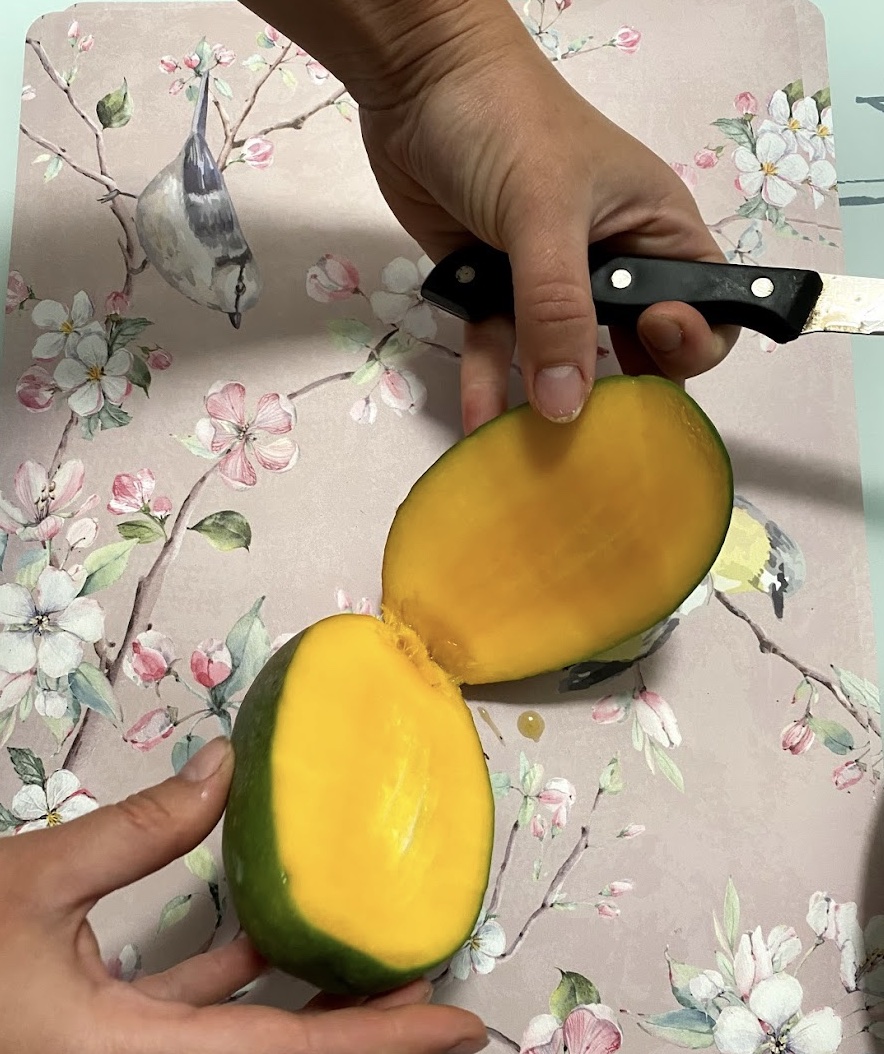
How to eat mango - cutting tip:
- Slice: Stand the mango on its shorter end and slice off two large pieces along the sides of the pit.
- Score a grid: Score the flesh side of each large piece in a grid pattern, but don’t cut through to the skin.
- Turn inside out: Turn the scored mango “cheek” inside out to form small cubes you can easily peel away from the skin.
My mango arrived firm — what now?
Did you order from us for the first time and feel disappointed after opening the package? The mango was firm and not beautifully red, as you had hoped. We completely understand that it can be a shock, and it’s important to explain what happened and how to avoid a negative reaction in the future. Air-freighted mango is harvested at full maturity, but that has nothing to do with how soft it feels. Mango maturity is determined by the harvest window of specific varieties and subtle pigment changes. Typically, these are small, lighter spots on the surface even on green fruit. Based on that, it’s decided that the fruit is ready to pick. We send your mango shortly after picking so it reaches you still firm. Leave it at room temperature at home and it w
Víte jak na mango?
List of ratings
 Jindriska Roubikova
 Robert Mandák
 Helena Mourková
 Běla Vávrovská
 Petra Kučerová
 Petr Kapitán
(Administrator)
Petr Kapitán
(Administrator)
 René Budnik
 Ivana Kanclířová
 Hana Vondráčková
 Jana Karlachová
 Jana Kudrnová
 Tereza Hošnová
 Jana Škaroupková
 Darina Hiscsáková
 Martina Kmůchová
 Lenka Michalcova
 Petra Buchtová
 Blanka Bezdíčková
 Radmila Haluzová
 Alena Kočí
 Jarmila Konopová